I was listening to an old recording in the car today:
Maybe by Thom Pace, the theme song for 70s TV show
The Life and Times of Grizzly Adams. There's a You Tube version
here (if you can handle the beard and lip-syncing).
Have a listen, and then listen to
Firefly's theme song (written by Joss Whedon, performed by Sonny Rhodes) which you probably already know because how could you not?
The fugitive who finds sanctuary in nature. The captain of a starship who'll do anything just to "keep her in the sky." Separated by seven centuries, their core emotions are perfectly captured in these two simple songs.
What I love about both these pieces is the emotional punch they pack while being both musically and lyrically so minimalist. When it comes to deep-seated feelings, give me understatement over histrionics any time. It's something I appreciate in lyrics, in acting, in books, in art, and because I'm British (at least, that's my excuse) in life.
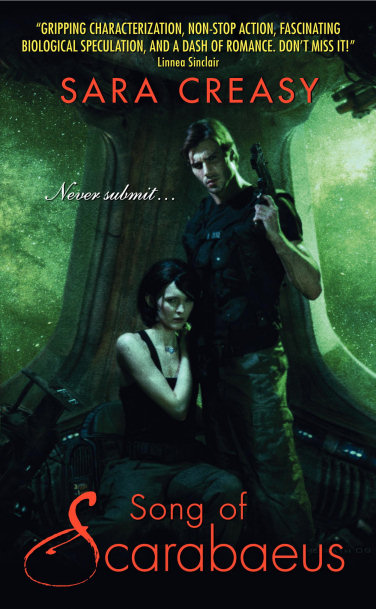
In writing, I think I gravitate toward that mode naturally - I write characters who don't give long speeches about their feelings and who don't fly off the handle or declare undying love at the drop of a hat. There are exceptions, because drama requires highs and lows and a good mix of personalities. Cat Lancer tends to say what she thinks even if it gets her into trouble. Haller has his little temper tantrums. Liv Natesa's infamous poise can be shattered. But even these characters don't barge through every page screaming "Here I am, and here's what I'm currently feeling!"
Understatement is of course most effective when emotions are running the hottest. Love, lust, anger, grief - for me, scenes that show characters struggling to hold in these feelings (because they fear the consequences, or because public displays are unacceptable, or because they're trained to be that way, and many other reasons) are more powerful than big splashes of overt expression. Holding it inside also builds tension - for the character and for the reader - and that has other interesting consequences. When will the character finally break loose (if ever)? What does all that suppressed emotion do to a person (if anything)? Most importantly, how will those emotions find their way out? Because it's bound to happen. I'm reminded of Colin Firth's Darcy, as uptight and controlled as they come. He's enjoying a quiet, humorous moment with Elizabeth at the piano when his aunt's overpowering voice from across the room ruins the mood: "What are you talking of? ... I must have my share in the conversation!" He doesn't lose his cool and burst open with all that suppressed upper class frustration. But the way he rolls his eyes... You know exactly what he thinks of her intrusion. Better still, he thinks that way
because Elizabeth Bennet is in his life and in his sights. Last week it might not have bothered him at all.
And for the reader, or viewer - as I learned in a screenwriting class a long time ago - the fewer tears a character sheds on screen, the more tears the audience sheds. If the reader knows from other clues what the character is feeling but the character reins it in, all that pent-up emotion has to find another outlet... it's released via the reader instead.
And now for the problem in all this: I'm not so sure that the majority of readers would agree with me. I'm not sure the majority of people in life are like this. Depending on their tastes and culture and gender, a lot of people evidently like to watch movies exploding with anger and violence, and soap operas drenched in melodramatic acting. A lot of people like to watch out-of-control displays of emotion in "real life" too - see Springer, Dr Phil, and any number of reality shows.
How far this translates to reading, where there are no additional clues from actors (whether talented or overwrought), I don't know. I like to think the reader should work just a little bit to extract emotion from the page, instead of having it handed to her on a platter by characters who act out (or describe) every last gram of what they're feeling. I think it makes the experience interactive.
And that's what happens when I listen to the two simple songs mentioned earlier. Because the lyrics are understated, the onus is on
me to feel the emotions inferred by them.